

MaNGaL
A description of the mechanical and optical design and details on the on-sky commissioning runs made on both telescopes (1-m Zeiss SAO RAS and 2.5-m KGO SAI MSU) are provided in Moiseev et al, 2020
Main parameters of MaNGaL at the SAO RAS and SAI MSU telescopes
| 1-m SAO RAS (Cassegrain, F/13) old camera |
2.5-m SAI MSU (Nasmyth-2, F/8) new camera |
|
|---|---|---|
| Total focal ratio: | F/5.26 | F/2.83 |
| IFP: | ET-50 IC Optical Systems Ltd | |
| Field of view: | 11.8′ | 7.0′ |
| Pixel scale: | 0.92′′ | 0.26′′ |
| Spectral range: | 460–750 nm | |
| Spectral resolution: | 1.0–1.5 nm | |
| Detector: | CCD TK1024 1024×1024 24×24 μm |
CMOS QHY4040 1600×1600 (fragment) 9×9 μm |
| Medium-band filters: | Edmund optics, FWHM = 10 - 25 nm, peak transmission ~ 95% | |
The parameters at the 1-m telescope are given with old camera lens ‘Helios-44M’. This camera was used until 2024 Mar. The parameters at the 2.5-m telescope are given with new camera ‘Canon RF 50mm f/1.2L USM’. Also CCD detector Andor iKon-M 934 (1024×1024 px, 13×13 μm in size) was used at 2.5-m telescope until 2023 Nov. In combination with old camera lens it provides 5.6 arcmin FOV with a sampling 0.33''/px.
Basic idea
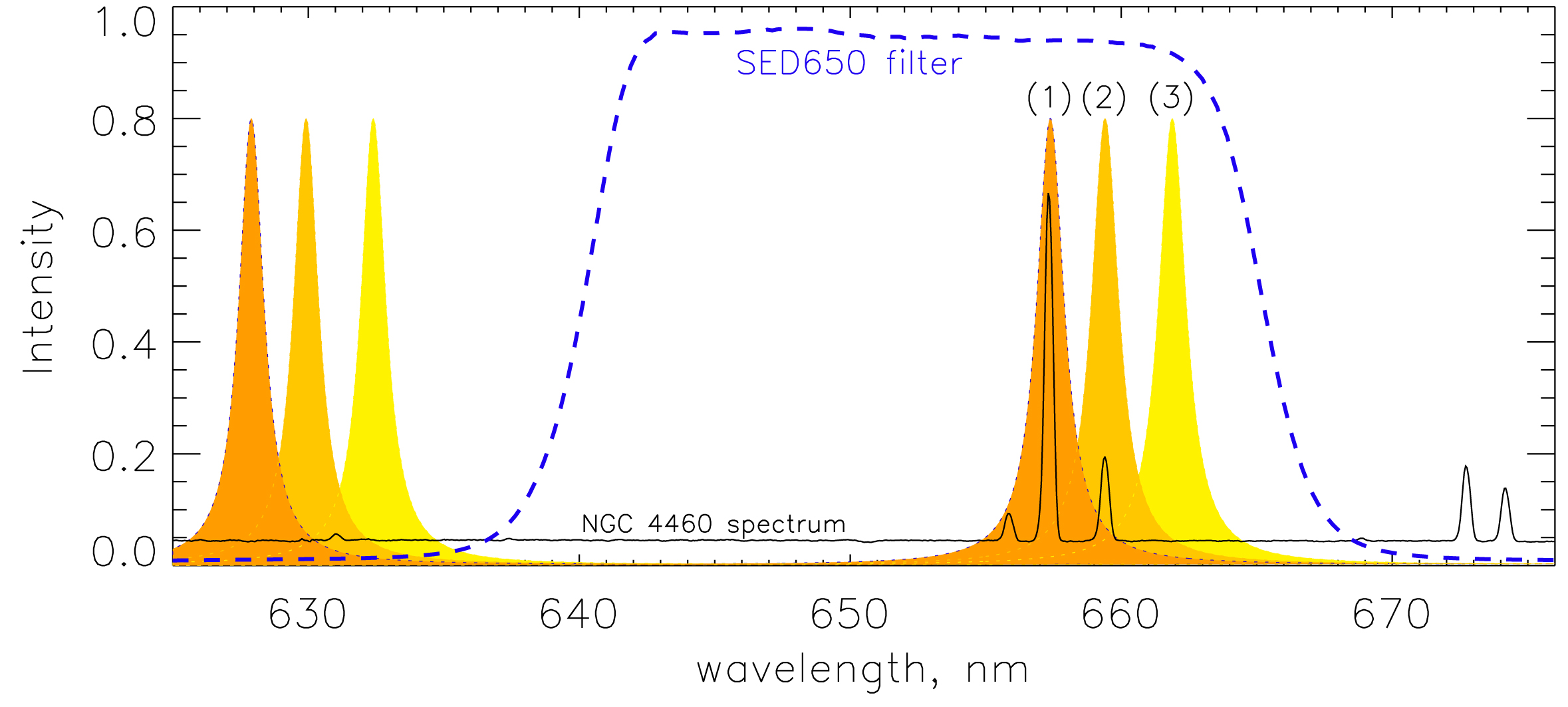
Tunable filter (TF) imaging systems based on low-order scanning Fabry-Perot interferometers (FPIs) have a long history of astronomical applications related to the study of extended emission-line targets: galactic and extragalactic nebulae, solar system objects. The main idea of observations are illustrated in the next Figure. If the gap between FPI plates is small and corresponds to the interference orders n = 10−30, then it is easy to attain the FWHM of the instrumental profile δλ = 1−2 nm. Since the distance between neighbouring interference orders (interfringe) δλ = λ/n, we can cut the desired transmission peaks by the medium-band filter with a typical bandwidth of about 15–30 nm. The peak transmission central wavelength (CWL) can be switched between the desired emission line and neighboring continuum using a piezoelectrically-tuned and servo-stabilized FPI; the redshift/systemic velocity of the studied objects can be taken into account.
Optical scheme
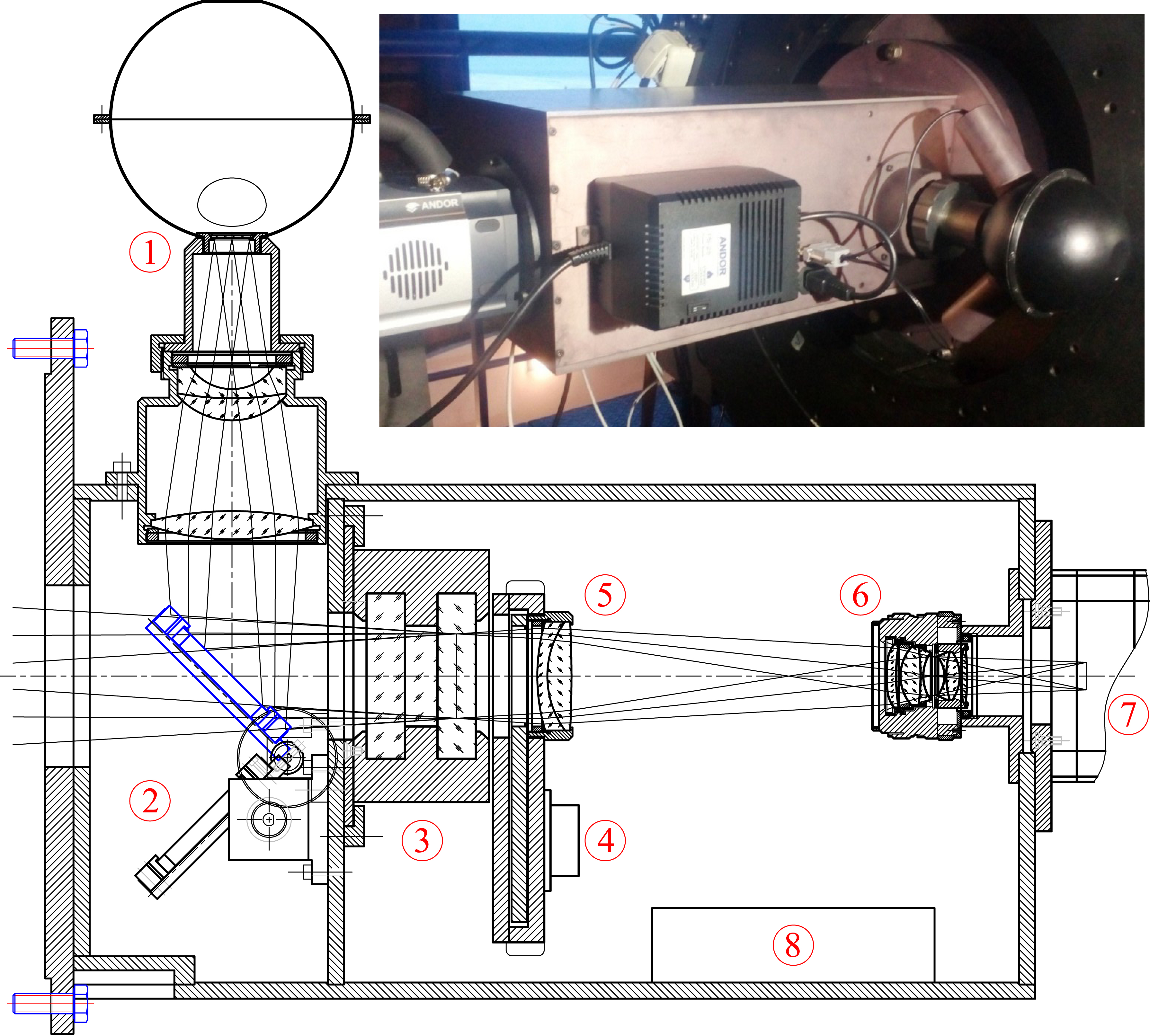
The instrument optical scheme consists of a two-component achromatic field lens and an anastigmatic photographic lens ‘Helios-44M-7’ (before 2024 Mar) and ‘Canon RF 50mm f/1.2L USM’ (after 2024 Mar). In contrast to the ‘classical’ optical layout having a TF in the collimated beam, MaNGaL is an afocal reducer with the FPI in the convergent beam. This arrangement provides a significantly larger size of a central monochromatic regions that is crucial in studying the extended targets.
Filters
We use hard coated bandpass filters also produced by Edmund Optics. The main set of the filters with the 25-nm bandwidth is similar to that described in Dodonov et al., 2017. These filters uniformly cover the 460–750-nm wavelength interval, their trans- mission curve has an almost rectangular shape with a maximum throughput of ~ 95%. Also, we use several filters with the 10-nm bandwidth which cover the spectral regions between the 25-nm filter profiles.