|
|
The blazar PKS 0735+178: a candidate for the source of mysterious neutrinos |
Russian version |
|
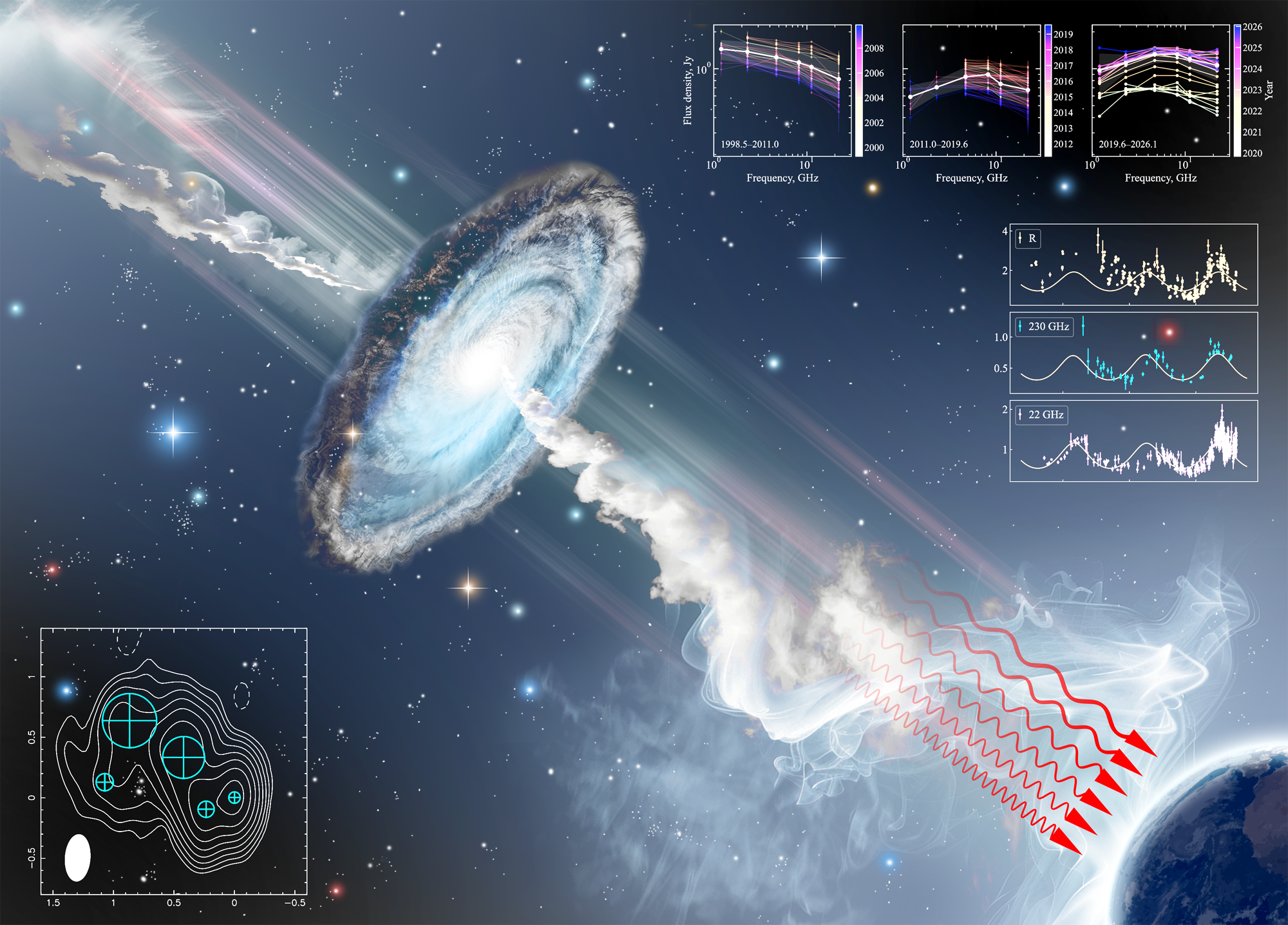
Scientists at SAO RAS, together with their Russian and international colleagues, are studying active galactic nuclei (AGNs): the most powerful objects in the Universe. The subclass of blazars is of particular interest due to the orientation of the relativistic jet emanating from regions near a supermassive black hole. In blazars, the jet is pointed toward Earth, and relativistic effects cause them to appear much brighter than they actually are (Fig. 1). Attention to blazars increased sharply after September 2017, when the IceCube observatory in Antarctica detected a neutrino particle with an incredibly high energy of 290 TeV (more than 200 trillion electron volts). It arrived from the direction of an ordinary blazar named TXS 0506+056. The detection of neutrinos of such energies has become possible in the last decade thanks to the commissioning of neutrino detectors located deep under water and ice, whose volumes are measured in cubic kilometers. The low accuracy of localizing the sources of such neutrinos does not allow reliable identification of specific objects that produced them. However, astrophysicists were able to discover a statistical connection between the position of bright AGNs in the sky and the direction of neutrino arrival. Most importantly, at the moment the neutrino arrives, these galaxies usually experience a powerful flare. Therefore, in recent years, AGNs are increasingly being considered as possible proton accelerators: it is known that neutrinos are produced via protons accelerated to near-light speed.
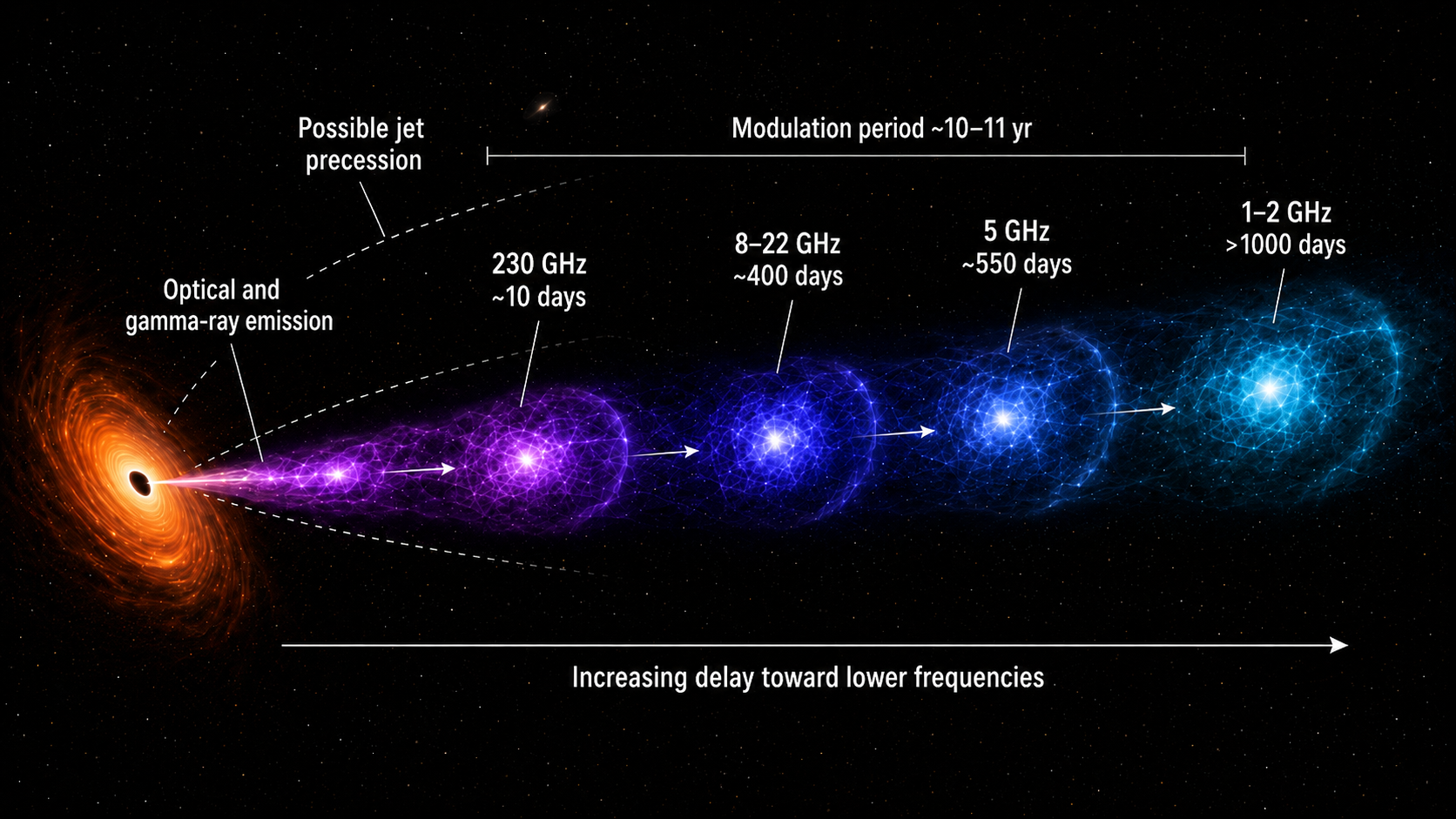
In December 2021, multiple detectors around the world — from Lake Baikal to Antarctica and the Mediterranean Sea — captured high-energy neutrinos originating from the direction of the bright blazar PKS 0735+178. To determine whether the 2021 event was an isolated episode or part of the source's long-term activity, SAO RAS scientists, together with Russian and international institutions, collected archival observed data for PKS 0735+178 over 30 years (1995–2026). These data were obtained using the SAO RAS telescopes, namely the RATAN-600 radio telescope and the Zeiss-1000 and AS-500/2 optical reflectors, as well as the Fermi-LAT orbital gamma-ray telescope and a dozen other ground-based observatories. By reconstructing the history of PKS 0735+178, astrophysicists discovered a number of interesting features: e.g., the blazar's nonthermal radiation (caused not by plasma heating but by particle acceleration in a magnetic field) first enhances in the gamma and optical ranges, then, after a delay of several years, flares as an echo in the radio range (Fig. 2). This pattern is consistent with modern concepts of a single radiation source: a population of relativistic electrons or protons emitting in a strong magnetic field within a jet emanating from the vicinity of the central supermassive black hole.
The second interesting feature is that in December 2021, the optical flare occurred 12 days before the gamma-ray flare, and the neutrino arrived precisely between them. This nearly two-week delay challenges the idea that the radiation originates from the same compact region of the jet. Instead, it signals that the flare first ignites in one region, then in another. This suggests that the emission zone and its structure are more complex than previously thought. The third feature is that the blazar emission has been measured to pulsate with a characteristic period of 10-11 years. This behavior is often explained by geometry: the jet oscillates like a spotlight, and we observe periodic flares. However, an independent assessment of the jet geometry based on radio interferometric observations has shown that this oscillation alone is insufficient to explain the periodic pulsations. Complex physical processes related to the propagation of a shock wave appear to be occurring within the jet itself, causing the material to emit differently at different distances from the black hole. The blazar PKS 0735+178 is a striking example of yet another piece of evidence linking neutrinos to AGNs. The observed patterns support the hypothesis that the neutrino arrival is associated with increasing AGN emission, and that the relativistic jet is an effective proton accelerator and the birthplace of these mysterious particles.
Published:
|