|
|
Probing Plasma Scattering Screens towards the Quasar 2005+403 with Long-Term RATAN-600 Observations |
Russian version |
|
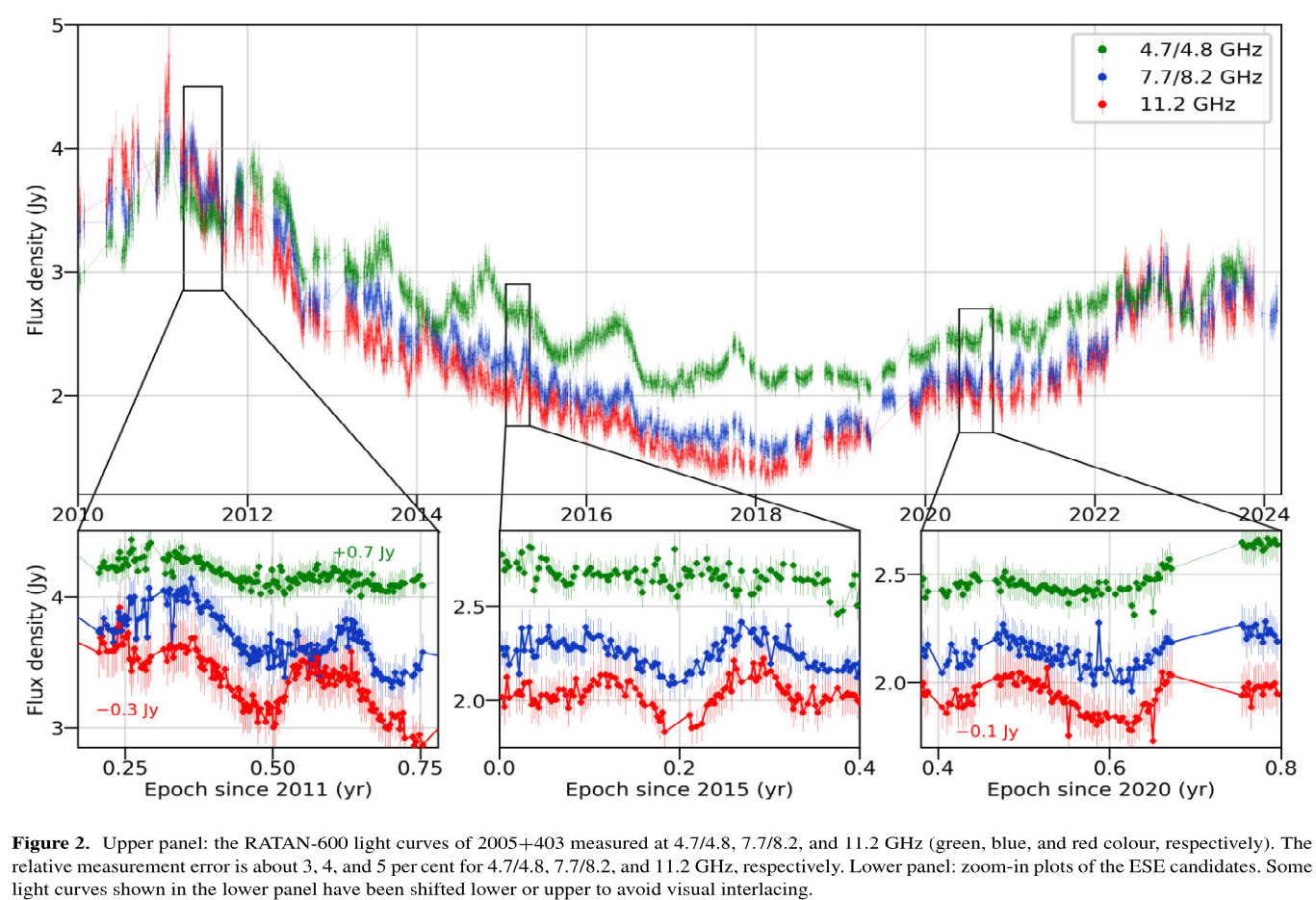
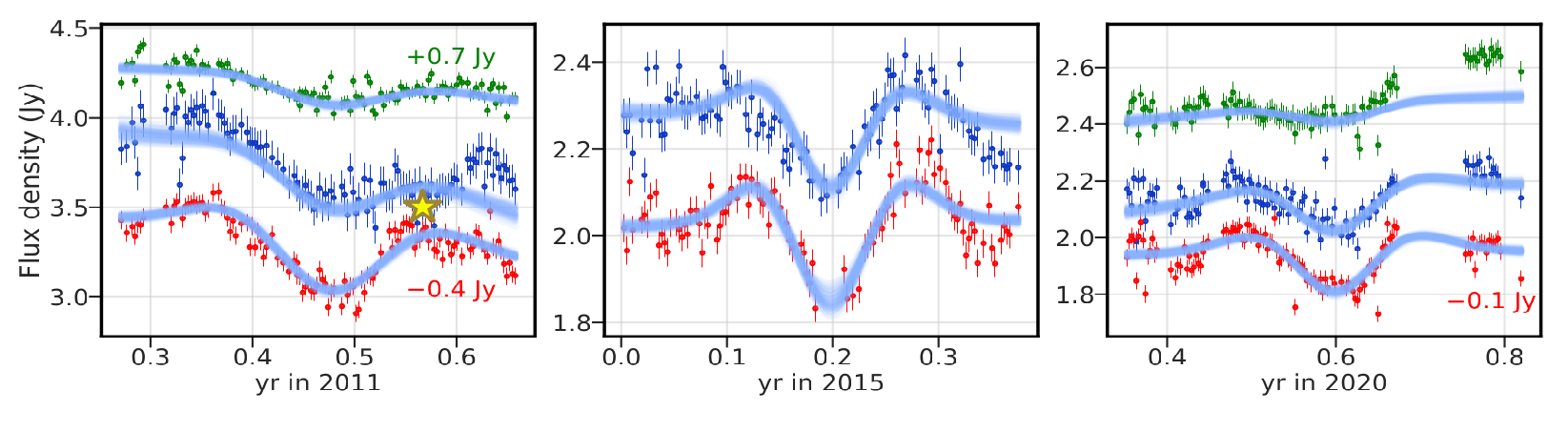
Based on the multi-frequency measurements of the quasar 2005+403, observed through thermal plasma in the gas-dust region Cygnus X in the interstellar medium (ISM) of the Milky Way, rare extreme scattering events (ESEs) of the radio flux from the source have been detected with the RATAN-600 radio telescope. For the first time, three characteristic variations in the flux density daily light curves of the quasar were detected on the light curves in 2011, 2015, and 2020. At frequencies of 4.8, 8.2, and 11.2 GHz, these events were fitted by a numerical model of a scattering lens, from which the following physical properties were derived: the average angular and linear sizes of the lens: 0.3 ± 0.1 mas, i.e., 0.6 ± 0.1 AU, the lens proper motion of 8.3 ± 0.7 mas per year, and the transverse velocity of the lens 70 ± 6 km/s (at distance to the lens 1.8 kpc). The electron density along the line of sight was 1200 ± 120 cm3, and the mass of each lens was found to be (0.8 ± 0.4) 10−15 M⊙. Crucially, the intrinsic angular size before scattering of the quasar 2005+403 was recovered as 1.57 ± 0.14, 0.95 ± 0.08, and 0.68 ± 0.04 mas at frequencies of 4.8, 8.2, and 11.2 GHz, respectively. Monitoring of the quasar in 2015–2016 showed, for the first time that six scattering lenses crossed the quasar’s line of sight one after another. We gain a better understanding of the evolving spatial structure of ISM on small scales and of the imaging properties of microquasars and quasars seen through the Galactic thermal plasma.
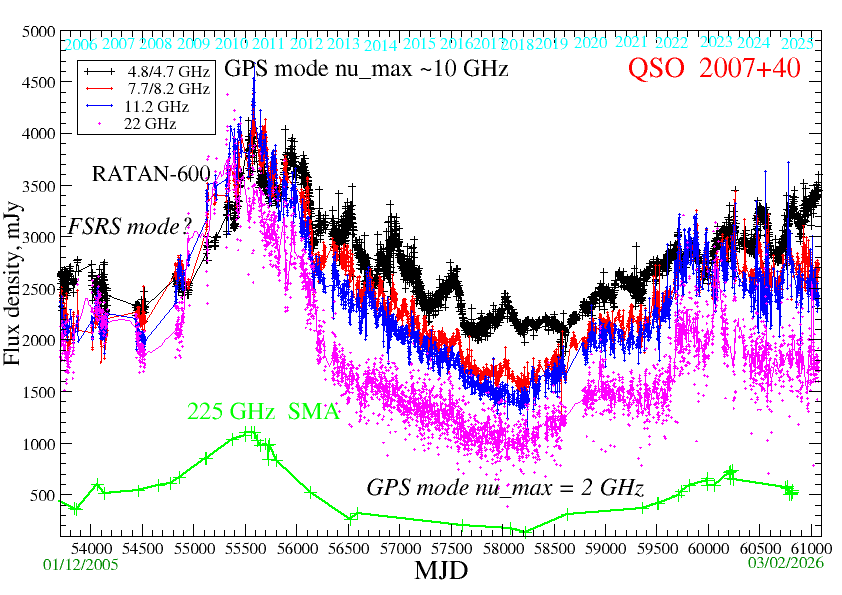
Figure 1 shows the quasar 2005+403 light curves from 2005 to 2026, measured with the RATAN-600 radio telescope at several frequencies. These data form part of a unique dataset monitoring the bright radio source, reliably measured at frequencies from 2.3 to 30 GHz over nearly 20 years. For comparison, the 225 GHz flux density light curve obtained with the SMA in the USA is shown. There is clearly a high correlation between the flux variations from 5 GHz to 225 GHz. There is every reason to believe that over the past twenty years the source has evolved from having characteristics typical of flat-spectrum radio sources (FSRS) to a source with a peak at 10 GHz (HPS) and finally to a source with a peak at 2 GHz (GPS).
We studied the light curves of the source measured at 4.7/4.8, 7.7/8.2, and 11.2 GHz to search for signs of radio-wave scattering. These light curves show the frequency-dependent time delay caused by the synchrotron opacity: the zDCF correlation analysis shows that at 11.2 GHz, the fluctuations occur about two months earlier than at 7.7/8.2 GHz, and about six months earlier than at 4.7/4.8 GHz. The 3.7-month delay corresponds to light curve variations at 7.7/8.2 GHz leading to changes at 4.7/4.8 GHz. It is established that the RATAN-600 light curves are characterized by variability over a wide range of timescales (from days to years). The longest timescale is about seven years and is clearly present at all frequencies. The long-term variability may be due to changes in Doppler enhancement, for example due to precession of the jets. Modulations observed on shorter timescales (1.5 years or less) are more likely related to propagation effects. Unusual high-amplitude flux-density oscillations with a timescale of 1.36 years were found only on the RATAN-600 4.7/4.8-GHz light curve up to 2018, which disappeared after 2018 and reappeared after 2020.
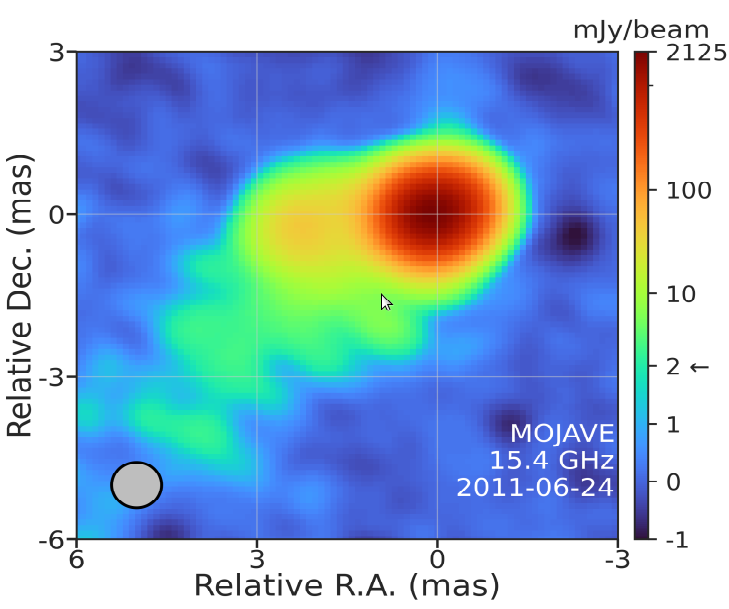
The image of the quasar 2005+403 at a frequency of 15 GHz, measured by the VLBA interferometer (USA) on June 24, 2011 and within the framework of the MOJAVE program at a frequency of 15 GHz; fortuitously, it coincided with the right caustic of extreme scattering, discovered in the RATAN-600 light curve at a frequency of 11.2 GHz, indicating the formation of a secondary image. At that time, the brightest feature was the innermost jet component rather than the core itself. Using structural modeling of the observed brightness distribution, we found fairly compelling evidence that refraction-dominated scattering is observed in both the core and the innermost element of the jet.
Extreme scattering events (ESEs) of the radio emission of the quasar 2005+403 were identified. The model light curves display characteristic flux drop patterns at all frequencies with no time shift, which is clearly related to the propagation properties of radio waves in the scattering medium. On both sides of the ESE moments, caustics are formed, which are brightenings of the flux, whose properties are determined by the ratio between the scattering lens and source (quasar) properties.
Published:
|