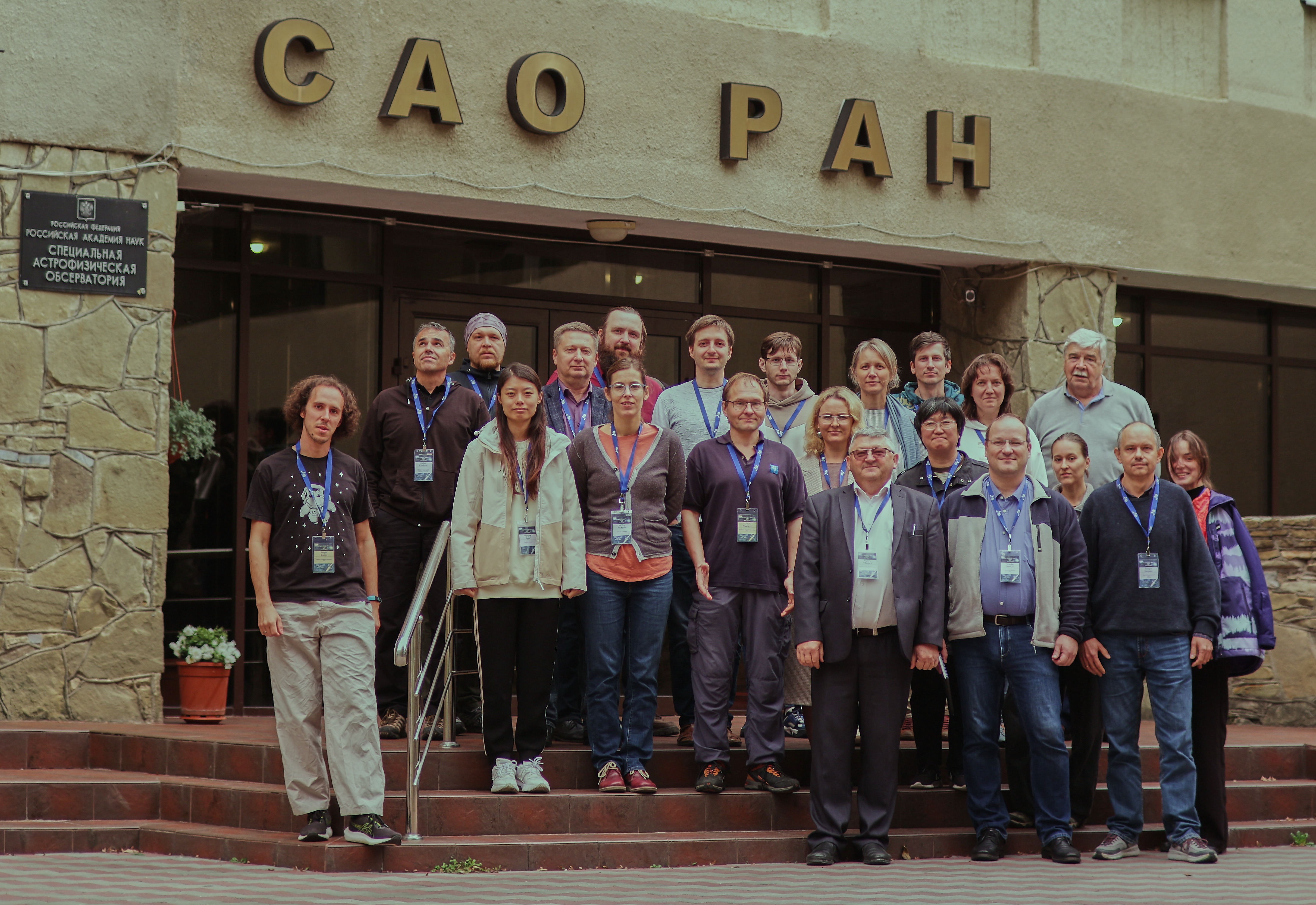

A leading center of the Russian ground-based observational astronomy, Special Astrophysical Observatory of the Russian Academy of Sciences, together with the Scientific Council for Astronomy of the Russian Academy of Sciences is organising an international conference "Active galaxies at different scales and wavelengths". The main purpose of the conference is the discussions of observation manifestations of the Active Galactic Nucleus (AGN) phenomenon on different spatial and time scales: from the central engine in the internal parsec — to the feedback processes in the host galaxy disk and beyond, from the interday flux variability — to the AGN duty cycle and cosmological evolution. The Conference is planned to be held in an in-person format.
The conference will focus on the following main topics:
- Physics of AGN Broad Line Regions, including Changing-look phenomenon, AGN monitoring from radio to X-ray
- AGN evolution and feedback processes revealed from multiwavelength and 3D spectroscopic surveys.
- Large-scale emission line structures in AGN hosts and intergalactic medium
Scientific Organizing Committee:
- Balashev Sergei (Ioffe Institute, Russia)
- Chen Yanmei (Nanjing University, China)
- Dodonov Sergei (Special Astrophysical Observatory, Russia)
- Ilic Dragana (Belgrade Observatory, Serbia)
- Moiseev Alexei (Special Astrophysical Observatory, Russia) — co-chair
- Popovich Luka (Belgrade Observatory, Serbia) — co-chair
- Sanchez Sebastian (UNAM, Mexico)
- Sazonov Sergei (Space Research Institute, Russia)
- Sotnikova Yulia (Special Astrophysical Observatory, Russia)
Local Organizing Committee:
- Arina Arshinova
- Chazov Maxim
- Korchagina Elena
- Kotov Sergei
- Kudryashova Anastasya
- Maricheva Margarita
- Moiseev Alexei — chair
- Oparin Dmitry
- Perepelitsyna Yulia
- Smirnova Aleksandrina
- Tepliakova Arina
- Uklein Roman
- Zhelenkova Olga
Confirmed invited speakers:
- An Tao (Shanghai Astronomical Observatory , China)
- Chen Yanmei (Nanjing University, China)
- Ilic Dragana (Belgrade Observatory, Serbia)
- Ho Luis (Kavli Institute for Astronomy and Astrophysics, Peking University)