Please see provided popular version of summary (PDF) of the obtained results.
XMP gas-rich dwarfs in nearby voids: candidate selection
S.A.Pustilnik, E.S.Egorova, Y.A.Perepelitsyna and A.Y.Kniazev
(Download full article in PDF).
We introduce a project aimed at systematically searching for eXtremely Metal-Poor (XMP) very gas-rich blue dwarfs in voids in the nearby Universe.
Several such galaxies were first identified in the course of an unbiased study of the galaxy population in the nearby Lynx-Cancer void. These very rare and unusual galaxies appear to be the best proxies for the so-called Very Young Galaxies defined recently in the model simulations by Tweed et al. (2018). We discuss the main properties of 10 prototype objects residing in nearby voids and formulate criteria to search for similar dwarfs in other voids.
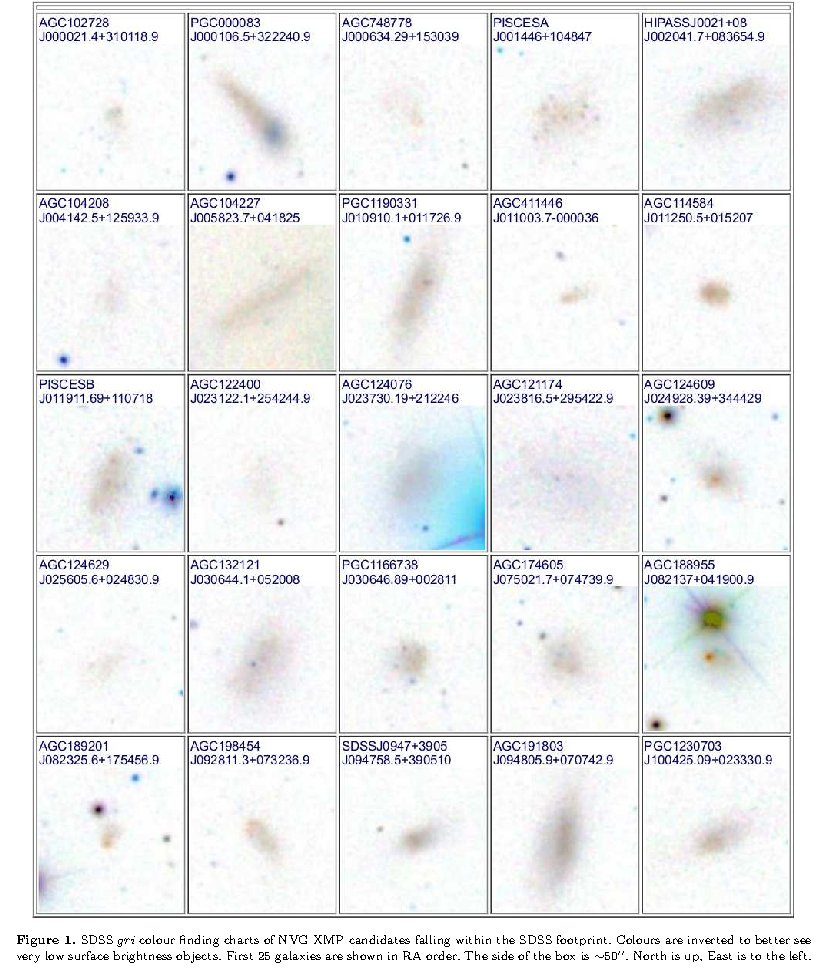
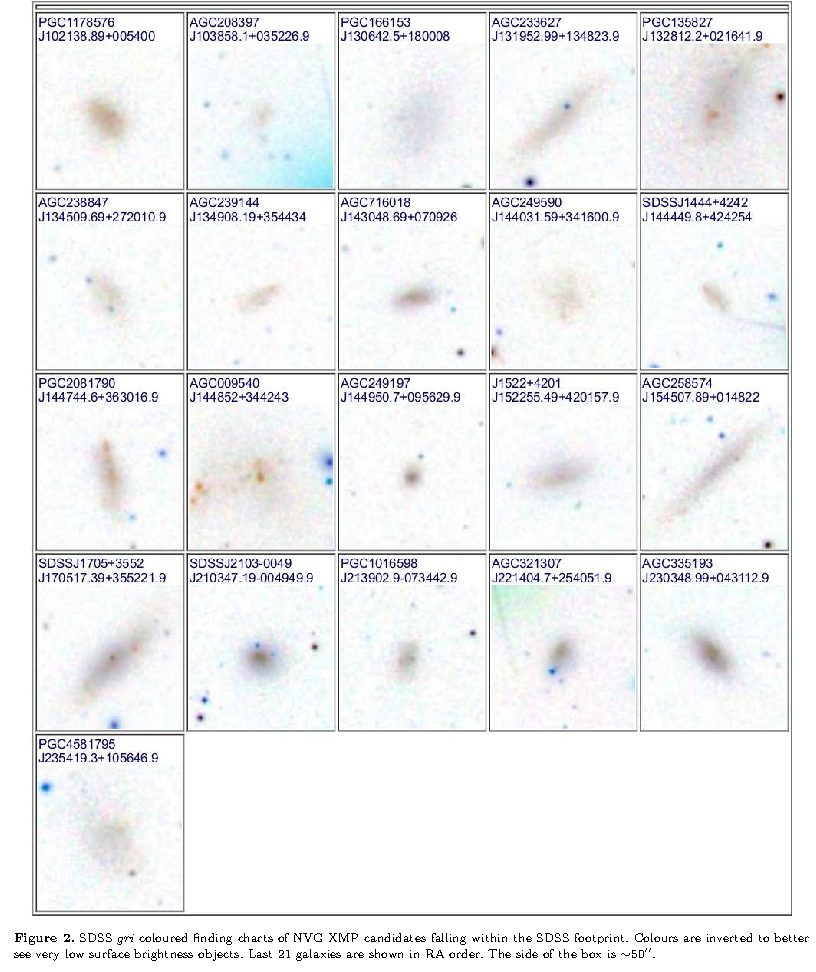
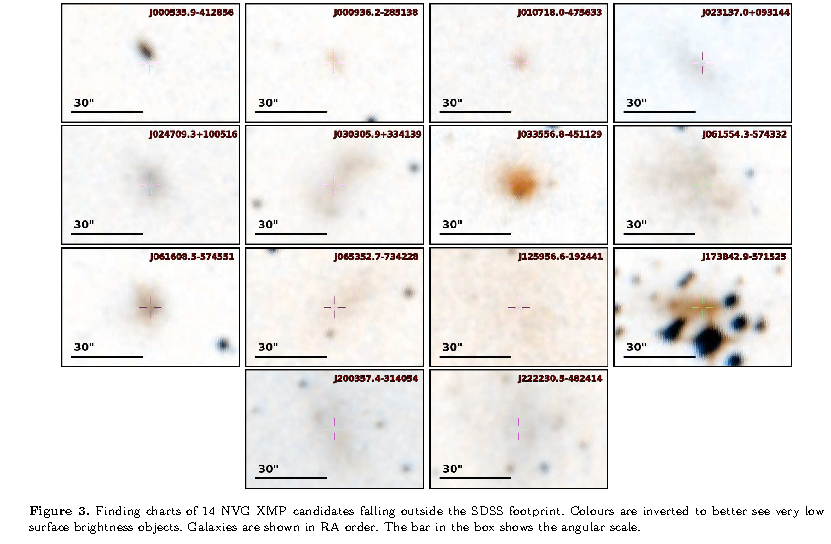
The recently published sample of 1354 Nearby Void Galaxies is used to identify a subsample of 60 void dwarf XMP candidates. We provide a list of these XMP candidates with their main parameters and finding charts. These candidates are the subjects of subsequent spectral, photometric, and HI studies in the accompanying papers. Looking ahead, with reference to the submitted accompanying papers, we find that this study results in the discovery of many new XMP dwarfs with
XMP gas-rich dwarfs in nearby voids: results of SALT spectroscopy
S.A.Pustilnik, A.Y.Kniazev, Y.A.Perepelitsyna and E.S.Egorova
(Download full article in PDF).
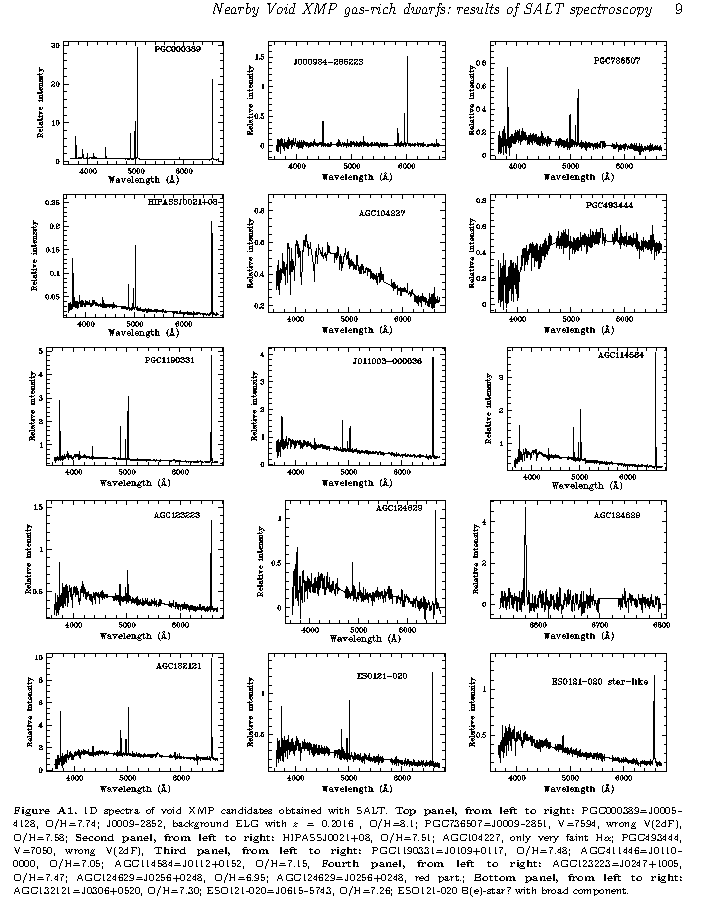
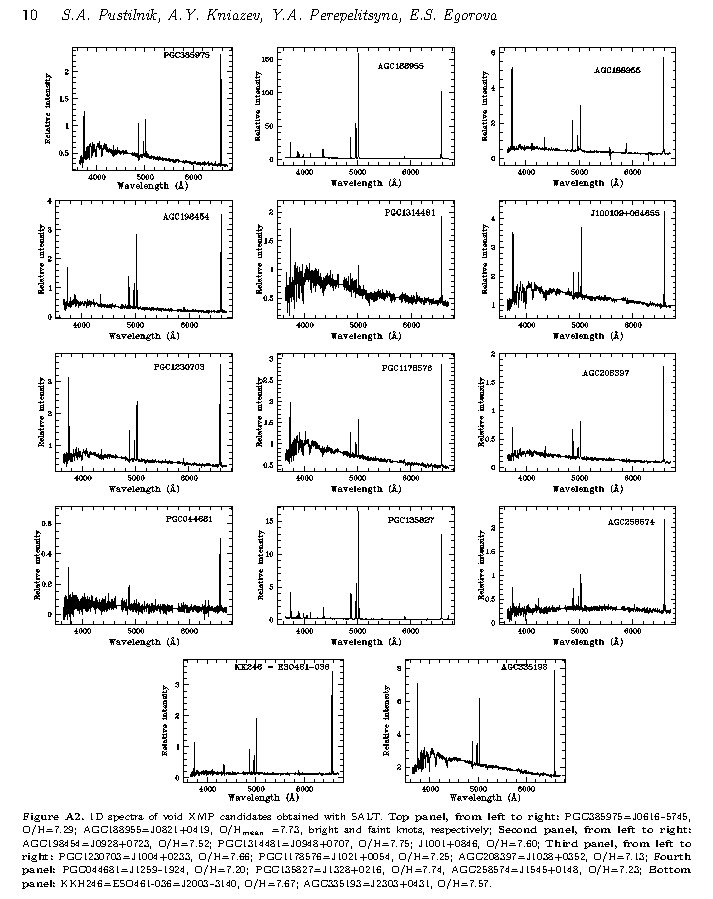
In the frame of the ongoing project aimed to the search for and study of nearby void eXtremely Metal-Poor (XMP) very gas-rich blue dwarfs, we conducted spectroscopy with 11-m Southern African Large Telescope (SALT) of 26 candidates, preselected in the first paper of this series (PEPK19). For 23 of them, we detected Oxygen lines allowing to estimate the value of gas . For ten of them, the oxygen abundance is found to be very low, in the range of Of them, 4 void dwarfs have , or . We discuss the obtained results for all observed in this work void dwarfs and compare them with all known for void galaxies. We also compare properties of the newly found unusual void XMP dwarfs with those for known prototype void XMP objects.
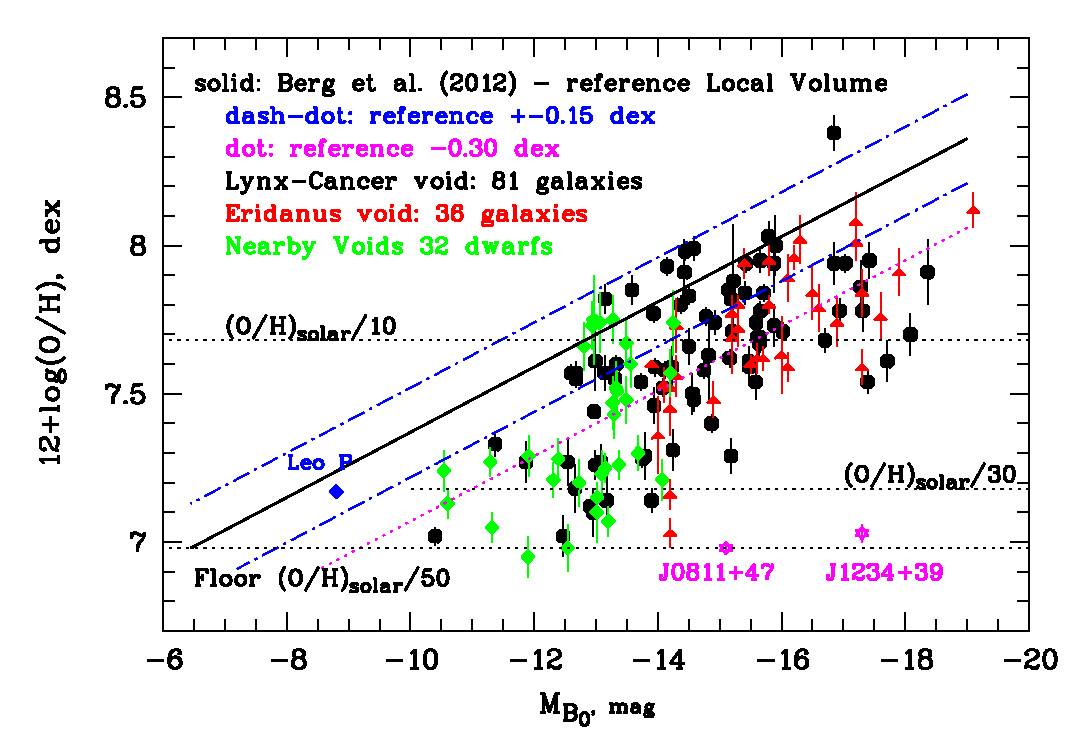
Positions of 22 studied with SALT NVG XMP candidates, plus one known from the literature (J2104–0035) and nine candidates from the BTA part of the program (a paper in preparation), in the diagram versus absolute blue magnitude (green rombs) along with similar data for voids Lynx-Cancer (black octagons, Pustilnik et al. 2016) and Eridanus (red triangles, Kniazev et al. 2018). The solid line shows the relation between and for the reference sample of the Local Volume late type galaxies from Berg et al. (2012), extrapolated for . Two outstanding distant record-low XMP BCGs J0811+4730 and J1234+3901 from the recent papers by Izotov et al. (2018, 2019) are shown by purple stars for comparison. See more detailed discussion in text.
XMP gas-rich dwarfs in Nearby Voids: results of BTA spectroscopy
S.A.Pustilnik, E.S.Egorova, Y.A.Perepelitsyna, A.L.Tepliakova, A.Y.Kniazev, A.N.Burenkov and D.Oparin
(Download full article in PDF).
We present the second part of results of the on-going project of searching for and studying eXtremely Metal-Poor (XMP, adopted as those with Z(gas) < Zo/30, or with 12+log(O/H) < 7.2) very gas-rich blue dwarfs in voids. They were first identified in course of the 'unbiased' study of galaxy population in the nearby Lynx-Cancer void. These very rare and unusual galaxies seem to be the best proxies of so-called Very Young Galaxies (VYGs) defined recently in model simulations by Tweed et al. To date, for 16 preselected void XMP candidates, we obtained with the SAO 6-m telescope (BTA) spectra suitable for determination of O/H. For majority of the observed galaxies, the principal line [OIII]4363A used for the direct classical Te method of O/H determination, is undetected. Therefore, to estimate O/H, we use the semi-empirical method by Izotov and Thuan, and when suitable, a new 'Strong-lines' method by Izotov et al. The latter is the most accurate empirical O/H estimator for the range of 12+log(O/H) < 7.4. Six of those 16 candidates are found to be the confident XMP dwarfs. In addition, eight studied galaxies are somewhat less metal-poor, with 12+log(O/H)=7.21 - 7.31. They also can fall into the category of VYG candidates. With account of the recently published by us and previously known (9 prototype galaxies) XMP gas-rich void objects, the new findings increase the number of this type galaxies to the total of 19.