The Edge-on Galaxy candidates in Pan-STARRS1 survey dr2 found by ANN
Examples
- Leda style: J000055.99+202017.1
- Alternative form: 00:00:55.99 +20:20:17.1
- In degrees: 182.767746 +50.484854
- within 1.5 degreeis radius 12:11:04.33 +50:29:06.1 r=1.5
Team
- Alexandra Antipova (SAO RAS)
- Dmitry Bizyaev (APO, SAI MSU)
- Svyatoslav Borisov (SAI MSU)
- Stefan Kautsch (NOVA)
- Dmitry Makarov (SAO RAS)
- Lidia Makarova (SAO RAS)
- Alexander Marchuk (SPbU)
- Alexander Mosenkov (Pulkovo Observatory)
- Vladimir Reshetnikov (SPbU)
- Sergey Savchenko (SPbU)
- Iliya Tikhonenko (SPbU)
- Pavel Usachev (SPbU)
Imfit 2D-decomposition of the PS1 edgeon galaxy candidates DR1
We started a new project on 2D-decomposition of the edge-on galaxies.Gallery
Superthin galaxy with a prominent pseudo-bulgeOne more example
S0 disk with a pseudo-bulge
Truncated disk with a dust lane
Three aligned dalaxies
A LSB Face-on galaxy projected on an edge-on one
Overheated disk
Polar ring (45 degree)
Interaction
Merging
Integral shape
Chain
Final sample
The final sample of the edge on galaxies in the Pan-STARRS dr2 survey contains 18314 candidates that meet the following conditions:- There are no "wrong" votes in visual classification.
- There is at least one "good" vote.
- The number of "unsuitable" votes is less than 75% of the total vote number.
The final sample contains 3350 of 5749 EGIS-galaxies and 2250 of 3029 RFGC-galaxies from the PS1 zone, Dec>-30.
Photometry comparison
We compared our automatic SExtractor (magPetro) r-band Pan-STARRS photometry with the aperture photometry of EGIS-galaxies based on SDSS data.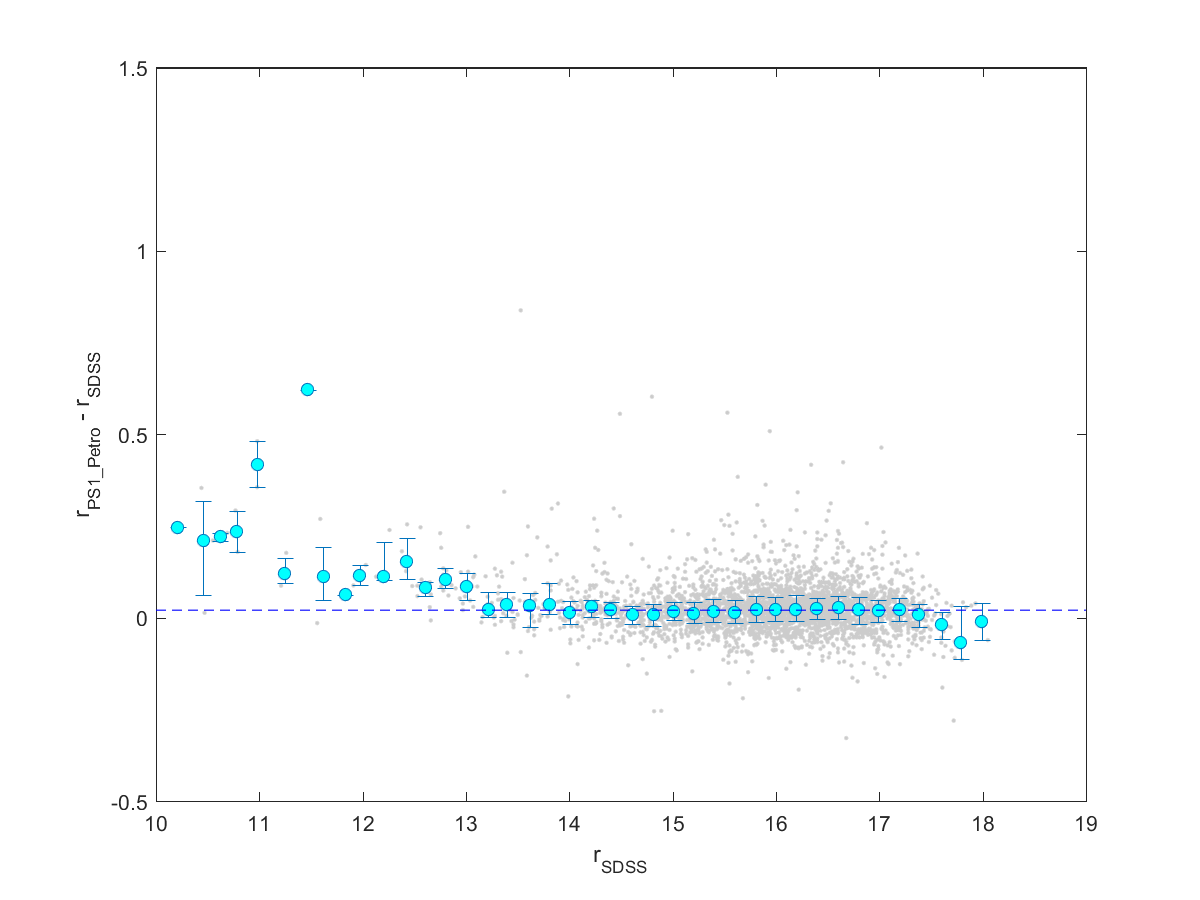
The systematic difference between PS1 and SDSS data is only
rPetro: Me(PS1-SDSS) = 0.00365 [-0.03068,0.03588] Sigma=0.0495.
rKron: Me(PS1-SDSS) = 0.02828 [-0.00373,0.06062] Sigma=0.0478.
The values in the brackets correspond to 25 & 75% quartiles.
The standard deviation is estimated using a median absolute deviation Sigma=1.4826*MAD.
Photometry refinement
Из анализа статистики и визуального просмотра кандидатов был составлен список примерно 5500 объектов с проблемами в автоматической SExtractor фотометрии. Был составлен скрипт для ручного подбора параметров для улучшения ситуации. Цель - подобрать параметры "nthresh" и "nthresh" так, чтобы во всех 5 grizy-фильтрах добиться наилучшего выделения областей принадлежащих галактике и недопущения излишней сегментации с одной стороны, и отделения фоновых звезд и галактик с другой. В дальнейшем SExtractor-фотометрия была выполнена для всех объектов, с учетом индивидуальных параметров.Cross-identification
Была выполнена кроссидентификация кандидатов с галактиками из базы данных HyperLeda. 21359 объекта из 22731 были отождествлены с известными галактиками, соответственно 1372 кандидата оказались новыми галактиками. Среди отождествленных три пары кандидатов оказались принадлежащих одним и тем же галактикам (3 шт). Список Pan-STARRS кандидатов в галактики, видимые с ребра, содержит 3590 из 5749 EGIS-галактик и 2435 из 3029, попадающих в облась Dec>-30, RFGC-галактик.Interesting cases
Jellyfish like galaxyTidal streams
Very prominent polar ring?
Interaction
The foreground objects looks like a jellyfish galaxy
The superimposed LSB galaxy
Classification system
A software for visual inspection of the candidates and its classification was developed. It has an interface similar to the zooniverse, but directly connected with the database. The advantage is an usage of Aladin Lite for visualisation of the objects. Aladin gives the possibility to inspect an object in different sky surveys as well as to zoom the image.Statistics on classification by people
This plot shows a ratio of votes which each participant gives to a particular class of edge-on galaxy candidates.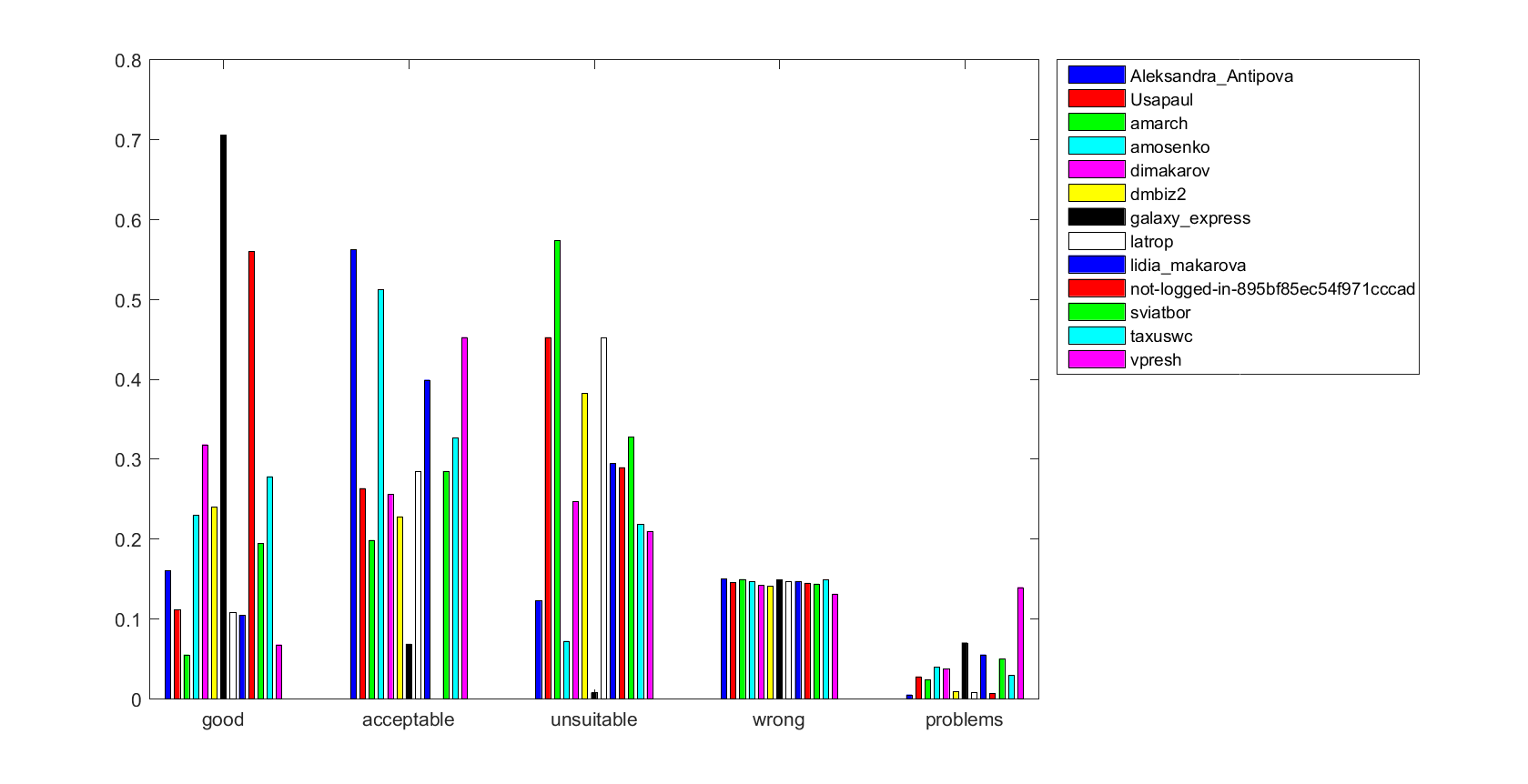
Artificial tests
The completeness map shows a probability of detection of candidates in edge-on galaxies by our ANN algorithm depending on central surface brightness and exponential radial scale.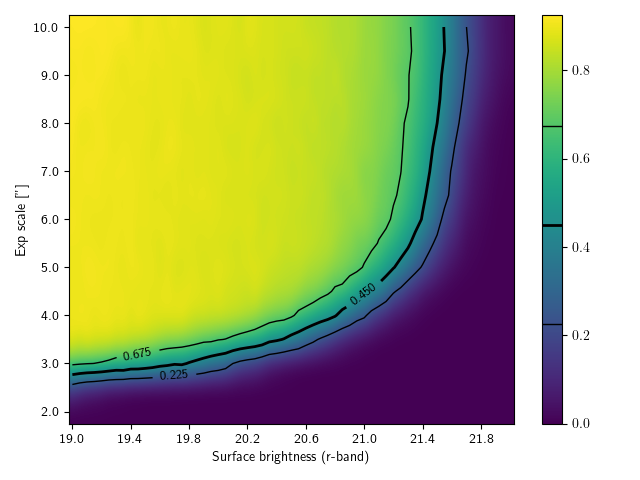
Visual inspection. Stage 1
We have finished the first stage of the visual classification of the candidates using the Zooniverse platform.Accepted designations
- GOOD
- Edge-on galaxy: 85 ≤ i ≤ 90 (good for analysis)
- Acceptable
- Nearly edge-on galaxy: 80 ≤ i ≤ 85 (acceptable for analysis)
- Unsuitable
- Not edge-on galaxy, but it could be a real galaxy or a pair of galaxies
- Problems
- Stars or defects significantly overlap with the body of the edge-on galaxy and can hurt further analysis
- Wrong
- Not a galaxy at all. It can be defects or asterisms.
| Impossible combination: GOOD+Wrong | 71 |
| Impossible combination: Acceptable+Wrong | 98 |
| Impossible combination: Unsuitable+Wrong | 81 |
| Suspected combination: GOOD+Unsuitable | 4013 |
The "impossible" combinations for 177 galaxies were revised and erroneous classifications were removed from the analysis.
| Voted as: | Counts |
|---|---|
| GOOD | 11877 |
| Silver sample: GOOD ≥ 50% | 4945 |
| Gold sample: GOOD ≥ 80% | 1794 |
| Acceptable | 16390 |
| Unsuitable | 12882 |
| Wrong cases | 4132 |
Artificial galaxy tests
To estimate the completeness of the catalog of edge-on galaxies in the Pan-STARRS we run a set of tests with artificial galaxies. The artificial galaxy is a pure exponential disk galaxy which varies in the central surface brightness, the radial exponential scale length and the vertical-to-radial scale length ratio. They are dropped down in random positions with random position angles within selected Pan-STARRS images. The image shows a preliminary map of the completeness of our edge-on galaxy catalog calculated by Sergey Savchenko.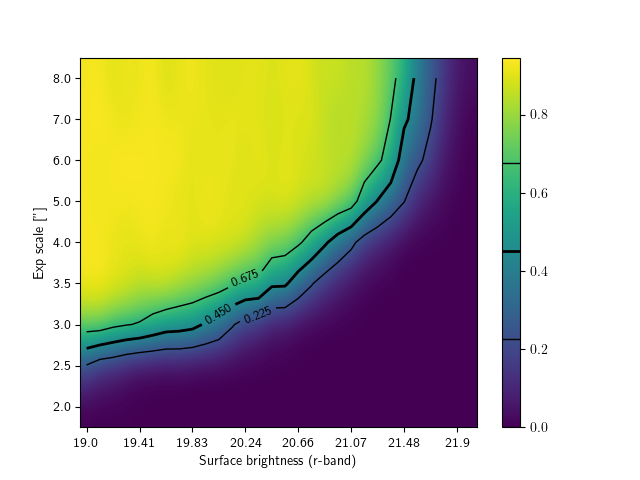
Visual inspection of the candidates
Despite the huge improvement in the quality of edge-on galaxy selection using ANN methodology, the final sample contains a significant number of objects that were falsely interpreted by ANN as edge-on galaxies. Typically miscalssified objects are asterisms, image defects, bright stars and real galaxies visible not from the edge. The interface was created by Dmitry Bizyev using the Zooniverse platform. The instruction was prepared by Alexander Mosenkov.
The Edge-on Galaxy database
This project was added to the Edge-on Galaxies Database by Dmitry Makarov.Training of the artificial neural network
For selection of the edge-on galaxies the artificial neural network was trained on a sample of the Edge-on Galaxies In SDSS (EGIS, Bizyaev et al. 2014) using the open source machine learning platform TensorFlow. It increased the number of correct detection up to 99.3 %. Finally, five models were trained and used simultaneously that allowed us to significantly decrease the number of wrong detections. As a result the 26587 candidates in the edge-on galaxies were selected. This stage was made by Sergey Savchenko.
- EGIS выборка галактик была разбита на тренировочную (80% от исходных галактик) и тестовую (оставшиеся 20%) подвыборки. Обучение проводилось по тренировочной подвыборке, а оценка правильных отождествлений была сделана по тестовой подвыборке галактик, Для увеличения объема исходной выборки был использован data augmenting: оригинальные галактики были немного модифицированы (использовалось зеркальное отражение, поверот на произвольный угол, изменение масштаба, добавление шума и т.д.). В результате из исходной выборки EGIS было сформировано 300.000 объектов для тренировочной выборки.
-
Были использованы сверточные нейросети.
Окончательная архитетктура состоит из:
- Сверточный слой 5x5x16 (размер свертки 5x5, число сверток 16)
- Сверточный слой 5x5x16
- batch-norm -- слой
- max-pooling -- слой
- drop-out -- слой
- Сверточный слой 5x5x32 (размер свертки 5x5, число сверток 32)
- Сверточный слой 5x5x32
- batch-norm -- слой
- max-pooling -- слой
- drop-out -- слой
- Сверточный слой 5x5x64 (размер свертки 5x5, число сверток 64)
- Сверточный слой 5x5x64
- batch-norm -- слой
- max-pooling -- слой
- drop-out -- слой
- полносвязный слой размером 500
- полносвязный слой размером 2 (собственно решение с ребра -- не с ребра)
В качестве функции везде, кроме последнего слоя используется ReLU, последний слой softmax.
Входные изображения масштабируются к размеру 48x48.
- batch-norm слой
- нормирует значения во входных данных, чтобы избежать очень больших и очень маленьких значений.
- max-pooling
- уменьшает размерность данных, выбирая только один максимальный элемент из куска NxN (использовалось 2x2)
- dropout
- позволяет сделать определенную долю нейронов неактивными. При каждом шаге тренировки в слое отключаются случайные нейроны. Это позволяет избежать переобучения, когда нейросеть просто запоминает конкретные изображения. Из-за того, что часть нейронов отключается, нейросети приходится действовать более умно и искать какие-то характерные паттерны, вместо зазубривания конкретных галактик, что нам и нужно. Когда обучение закончено, и нейросеть используется для анализа данных дропаут слои игнорируются и все нейроны активны (их возросшее число компенсируется нормировкой). В работе была выбрана доля отбрасываемых нейронов равная 0.3.
Для справки:
First attempt
In the first stage we tried to understand the possibility of using an automatic catalog of objects generated by Pan-STARRS for selection of the edge-on galaxies. As a reference sample we have used the Revised Flat Galaxies Catalog (RFGC) by I. Karachentsev et al. (1999). The aim was
- to find a correspondence between properties of the RFGC galaxies and the objects from the automatic Pan-STARRS catalog
- to pick up a selection criterion and to estimate the loss rate and the amount of wrong objects